
QUICK ACCESS
Current Issue
Vol. 27 No. 1 (2026): January-June 2026
Sociae Polites published eight (8) articles in the edition of January–June 2026 (Volume 27, Number 1). The first article, “UK’s Destination Branding through Netflix’s Bridgerton: Soft Power, Screen Tourism, and Post-Pandemic Tourism Recovery” by Pande Made Indira Pradnyani and I Made Anom Wiranata, examines how the UK government utilized the Netflix series Bridgerton as a soft power instrument for destination branding. The study highlights integrated strategies that strengthened the UK’s tourism recovery while demonstrating the role of popular culture in enhancing national branding.
In the second article, Cifebrima Suyastri reviews “A Scoping Review of Refugee Advocacy Models: Mapping Approaches, Strategies, and Implications.” The study identifies key advocacy approaches that strengthen refugee protection and emphasizes the importance of multi-stakeholder collaboration and sustainable policy development.
The third article by Le Hong Viet, Tran Thi Nhat, Nguyen Thi Danh Lam, and Van Viet Nguyen focuses on “Awareness, Attitudes, and Willingness to Participate in Community-Based Forest Management: A Case of Song Hinh Protection Forest, Vietnam.” The findings show that positive attitudes play a greater role than socio-economic factors in encouraging participation, highlighting the importance of environmental education and community engagement.
In the fourth article, “The U.S. Shipbuilding Policy under the Trump 2.0 Administration and Strategic Competition,” Nguyen Hop Chau and Do Manh Hoang examine the revival of the U.S. shipbuilding industry amid strategic competition with China. The study discusses its implications for global maritime dynamics and the opportunities and challenges faced by Vietnam.
The fifth article, written by Verdinand Robertua and Ruth Margaretha, examines “Indonesia’s Environmental Diplomacy under the Joko Widodo Administration (2014–2024): A Critical Constructivist Perspective.” The study argues that Indonesia’s environmental diplomacy has primarily served as a strategy of identity-building, while revealing inconsistencies between international commitments and domestic implementation.
In the sixth article, Suci Putri Salma and Muhammad Jamal investigate “Examining the Initial Impacts of the Samarinda Terrace Program on Quality of Life and Sustainable Environmental Governance through a Participatory Approach.” The study finds that the program has improved social interaction and local economic opportunities, while emphasizing the need for more collaborative governance to ensure its long-term sustainability.
The seventh article, “Redefining Political Education in the Digital Era: Political Party Funds and Digital Citizenship Maturity in Indonesia,” by Nanda Rizka Syafriani Nasution and Hendika Dwinanda Wicaksana, examines the role of political party funding in promoting digital citizenship maturity in Indonesia. The study finds that current political education programs have yet to effectively foster digital competencies, emphasizing the need to reform party fund governance and strengthen digital democracy through citizen empowerment.
The eighth article, “Fulfillment of Audience Needs and Satisfaction on the GadgetIn YouTube Channel (Netnographic Analysis),” by Medeline Grace A. Rahawarin and Chontina Siahaan explores how GadgetIn’s YouTube content fulfills audience needs through a netnographic approach. The study shows that the channel effectively satisfies audiences’ informational, entertainment, personal integrative, and social integrative needs, highlighting the role of technology-focused digital content in enhancing audience engagement and satisfaction.
Published:
2026-06-30
Articles
Why Publish With Sociae Polites
We are committed to supporting you throughout your publishing “journey” – from submission, through peer review, to publication and promotion
Open Access
Sociae Polites is a strong supporter of open access (OA). All the research articles published in Sociae Polites are fully open access.



Refereed
Peer review process - Committed to serving the scientific community. Sociae Polites uses a blind peer-review process.
Read moreIndexed
The journal is indexed and abstracted in sinta, crossref, dimensions, Google Scholar.
Read moreSinta 4
Sociae Polites is accredited Sinta 4 by the Ministry of Education and Research of the Government of Indonesia.
Read more
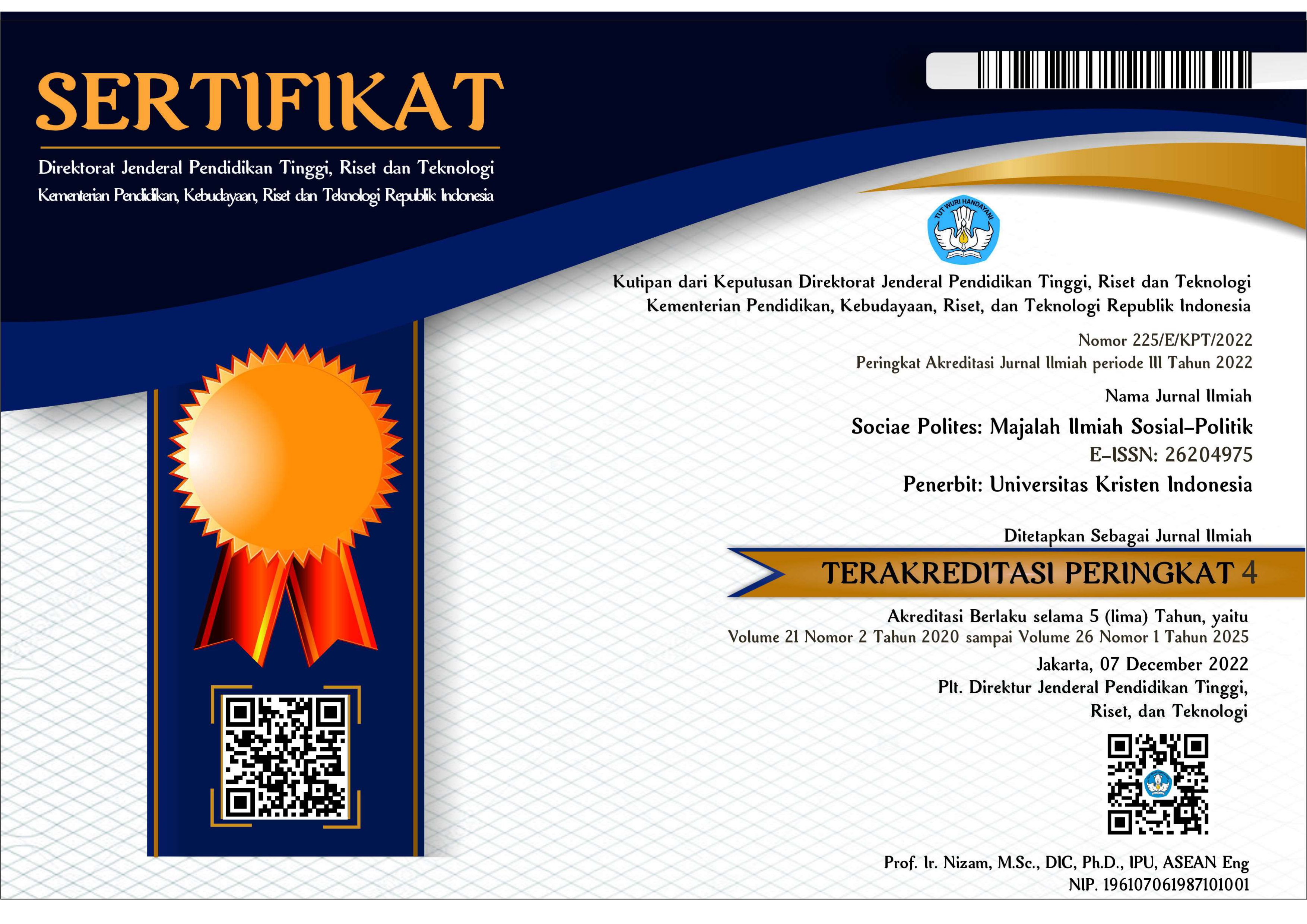 Sociae Polites: Majalah Ilmiah Sosial Politik