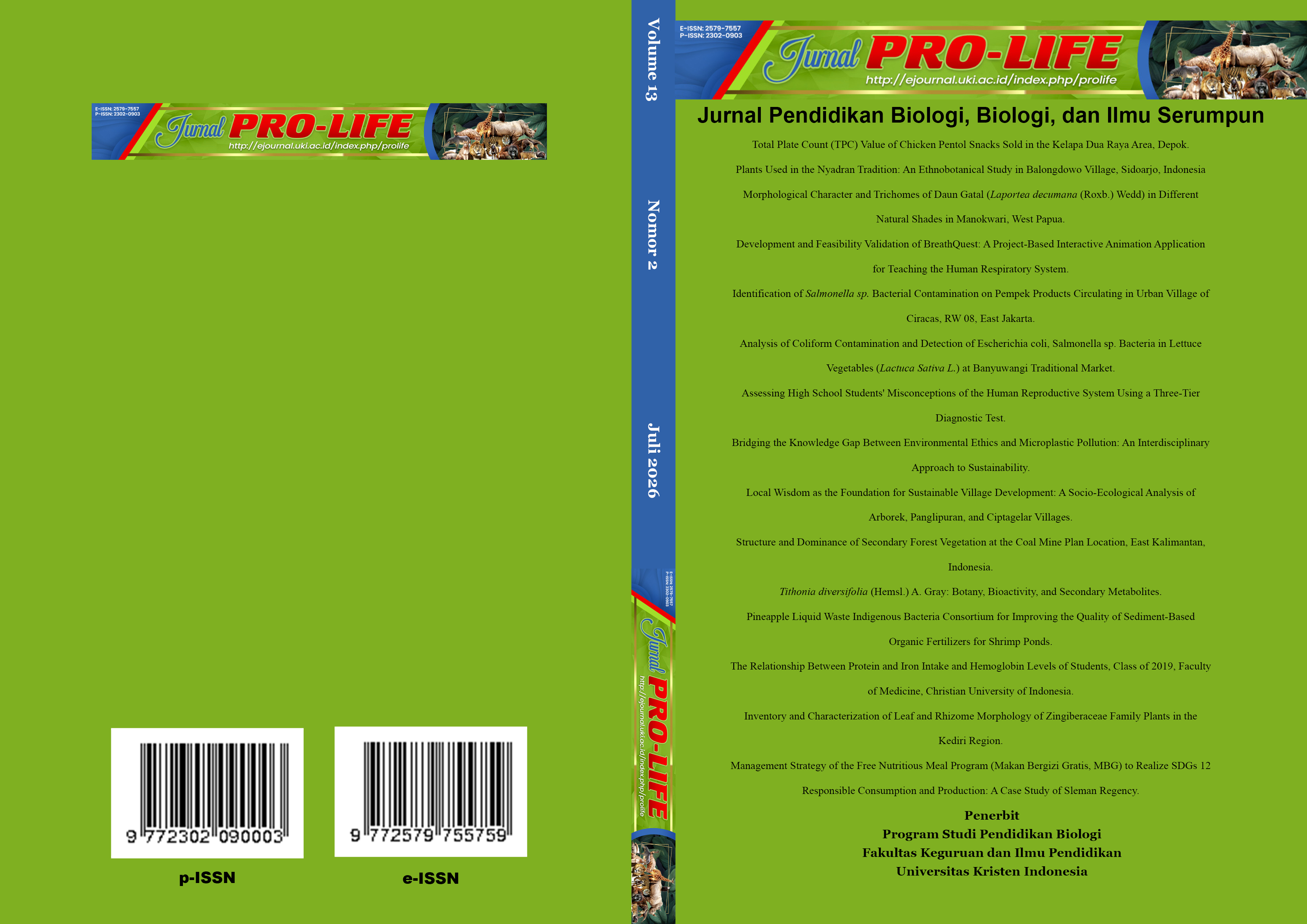
Assessing High School Students' Misconceptions of the Human Reproductive System Using a Three-Tier Diagnostic Test
DOI:
https://doi.org/10.33541/pro-life.v13i2.8236Keywords:
Misconception, reproductive system, three-tier diagnostic test, high school studentsAbstract
Misconceptions about reproductive system topics remain a persistent challenge in high school biology learning. This study aimed to assess students' misconceptions about the reproductive system using a three-tier diagnostic test. A descriptive quantitative method was employed involving 57 twelfth-grade students from a senior high school in Parepare, South Sulawesi. Data were collected using a three-tier diagnostic test covering six reproductive system subtopics and analyzed descriptively by classifying students' conceptions into scientific understanding (SU), misconception (Mi), and lack of knowledge (LoK). The results revealed misconceptions across all six subtopics of the reproductive system. The highest percentage of misconceptions was found in reproductive hormone regulation (38.60%), followed by gametogenesis (35.09%). Meanwhile, the highest percentage of lack of knowledge was observed in reproductive system disorders (45.61%) and gametogenesis (43.86%). In contrast, reproductive organs showed the highest percentage of scientific understanding (57.89%). Overall, the findings indicate that students still experience considerable misconceptions and conceptual difficulties in several reproductive system subtopics, particularly those involving abstract processes and hormonal mechanisms. These findings highlight the need for targeted instructional interventions, especially in subtopics with high rates of misconceptions and lack knowledge levels, to support conceptual change and improve students' scientific understanding.
References
Abbas, S. S., Eldin, A. S., & Elsayed, A. (2018). The effect of concept mapping and mind mapping utilization on students' understanding level: An empirical study. Proceedings of the Eighth International Conference on Concept Mapping.
Achor, E. E., Ellah, B. O., & Omaga, J. O. (2022). Misconceptions and difficult concepts as determinant of students' academic engagement and retention in physics. Jurnal Varidika, 34(1), 42–52. https://ssrn.com/abstract=4161608
Allen, M. (2025). Misconceptions in primary science (4th ed.). McGraw-Hill Education.
Amiruddin, M. Z., Samsudin, A., Suhandi, A., Kaniawati, I., & Coştu, B. (2025). The impact of refutation texts in scientific conception: A meta-analysis. Jurnal Pendidikan MIPA, 26(1), 153–168. https://doi.org/10.23960/jpmipa.v26i1.pp153-168
Ampatzidis, G., & Armeni, A. (2022). Human reproduction in Greek secondary education textbooks (1870s to present). In K. Korfiatis & M. Grace (Eds.), Current research in biology education (pp. 257–268). Springer. https://doi.org/10.1007/978-3-030-89480-1_20
Andariana, A., Zubaidah, S., Mahanal, S., & Suarsini, E. (2020). Identification of biology students' misconceptions in human anatomy and physiology course through three-tier diagnostic test. Journal for the Education of Gifted Young Scientists, 8(3), 1071–1085. https://doi.org/10.17478/jegys.752438
Appiah-Adjei, A. A., Agyei, A. C., & Gyamfi, M. (2025). From theory to real life: Elevating biology students' performance in ecology with context-based learning. American Journal of Science Education Research, 248(1), 2–21. https://doi.org/10.71010/AJSER-2025-e248
Arslan, H. O., Cigdemoglu, C., & Moseley, C. (2012). A three-tier diagnostic test to assess pre-service teachers' misconceptions about global warming, greenhouse effect, ozone layer depletion, and acid rain. International Journal of Science Education, 34(11), 1667–1686. https://doi.org/10.1080/09500693.2012.680618
Aruan, D. N., Adinugraha, F., Ratnapuri, A., & Setiati, N. (2025). Integrating comic into biology education handout: Enhancing reproductive health learning at SMA 1 Cawang Baru. Jurnal Pro-Life, 12(1), 51–62. https://doi.org/10.33541/pro-life.v12i1.6639
Astiti, D. T., Ibrahim, M., & Hariyono, E. (2020). Application of POE (predict–observe–explain) learning strategies to reduce students' misconceptions in science subjects in elementary school. International Journal of Innovative Science and Research Technology, 5(7), 437–445. https://doi.org/10.38124/ijisrt20jul478
Aulia, N., & Christijanti, W. (2024). Efforts to improve high school students' activities and learning outcomes on the human reproductive system material with the implementation of problem-based learning assisted by "Gen Z." Journal of Biology Education, 13(3), 282–288.
Baharuddin, R., Surtikanti, H. K., & Riandi, R. (2023). Literature review: The use of augmented reality learning media oriented towards science process skills to enhance student understanding and scientific attitudes towards genetics. Journal of Biology, 6(2), 87. https://doi.org/10.35580/btl.v6i2.56836
Bolin, A., Whelehan, P., Vernon, M., & Antoine, K. (2021). Human sexuality: Biological, psychological, and cultural perspectives. Routledge.
Borovicza, B., & Szarka, K. (2023). A review of diagnostic assessment tools used in studies to uncover misconceptions in science education. INTED2023 Proceedings, 967–973. https://doi.org/10.21125/inted.2023.0297
Cense, M., de Neef, M., & Visscher, W. (2018). Culture, religion and sexual and reproductive health & rights. Rutgers. https://rutgers.international/resources/culture-religion-and-sexual-and-reproductive-health-rights/
Chen, C., Sonnert, G., Sadler, P. M., Sasselov, D., & Fredericks, C. (2020). The impact of student misconceptions on student persistence in a MOOC. Journal of Research in Science Teaching, 57(6), 879–910. https://doi.org/10.1002/tea.21616
Chew, S. L., & Cerbin, W. J. (2021). The cognitive challenges of effective teaching. The Journal of Economic Education, 52(1), 17–40. https://doi.org/10.1080/00220485.2020.1845266
Cukurova, M., Bennett, J., & Abrahams, I. (2018). Students' knowledge acquisition and ability to apply knowledge in different science contexts in two independent learning settings. Research in Science & Technological Education, 36(1), 17–34. https://doi.org/10.1080/02635143.2017.1336709
Dellantonio, S., & Pastore, L. (2021). Ignorance, misconceptions, and critical thinking. Synthese, 198(8), 7473–7501. https://doi.org/10.1007/s11229-019-02529-7
Dongarwar, D., & Salihu, H. M. (2019). Influence of sexual and reproductive health literacy on single and recurrent adolescent pregnancy in Latin America. Journal of Pediatric and Adolescent Gynecology, 32(5), 506–513. https://doi.org/10.1016/j.jpag.2019.06.003
Fauzi, A., Rosyida, A. M., Rohma, M., & Khoiroh, D. (2021). The difficulty index of biology topics in Indonesian senior high school: Biology undergraduate students' perspectives. JPBI (Jurnal Pendidikan Biologi Indonesia), 7(2), 149–158.
Ghavami, B., Sohrabi, Z., Raisi Dehkordi, Z., & Mohammadi, F. (2024). Relationship between reproductive health literacy and components of healthy fertility in women of reproductive age. Journal of Education and Health Promotion, 13(1). https://doi.org/10.4103/jehp.jehp_132_23
Gilissen, M. G. R., Knippels, M.-C. P. J., & van Joolingen, W. R. (2021). Fostering students' understanding of complex biological systems. CBE—Life Sciences Education, 20(3), Article ar37. https://doi.org/10.1187/cbe.20-05-0088
Guerra-Reyes, F., Guerra-Dávila, E., Naranjo-Toro, M., Basantes-Andrade, A., & Guevara-Betancourt, S. (2024). Misconceptions in the learning of natural sciences: A systematic review. Education Sciences, 14(5), 497. https://doi.org/10.3390/educsci14050497
Hasyim, W., Suwono, H., & Susilo, H. (2018). Three-tier test to identify students' misconceptions of the human reproductive system. Jurnal Pendidikan Sains Universitas Negeri Malang, 6(2).
Istiyono, E. (2022). Diagnostic tests as an important pillar in today's physics learning: Four-tier diagnostic test as a comprehensive diagnostic test solution. Journal of Physics: Conference Series, 2392(1), Article 012001. https://doi.org/10.1088/1742-6596/2392/1/012001
Jenkinson, J. (2018). Molecular biology meets the learning sciences: Visualizations in education and outreach. Journal of Molecular Biology, 430(21), 4013–4027. https://doi.org/10.1016/j.jmb.2018.08.020
Johnstone, A. H. (1991). Why is science difficult to learn? Things are seldom what they seem. Journal of Computer Assisted Learning, 7(2), 75–83. https://doi.org/10.1111/j.1365-2729.1991.tb00230.x
Kusumawardani, A. F., Noor, M. F., Amaliyah, S. (2025). Utilizing concept maps to uncover misconceptions in biology. Jurnal BIOEDUIN, 2, 1–11.
Li, X., Wang, W., & Li, Y. (2022). Systematically reviewing the potential of scientific argumentation to promote multidimensional conceptual change in science education. International Journal of Science Education, 44(7), 1165–1185. https://doi.org/10.1080/09500693.2022.2070787
Lieu, R. M., Gutierrez, A., Shaffer, J. F., Lieu, R. M., Gutierrez, A., & Shaffer, J. F. (2018). Student perceived difficulties in learning organ systems in an undergraduate human anatomy course. HAPS Educator, 22(1), 84–92. https://doi.org/10.21692/haps.2018.0
Lodang, H., Baharuddin, R., Kurnia, N., & Saenab, S. (2022). Pengembangan perangkat pembelajaran berbasis pendekatan saintifik materi pembelahan sel kelas XII SMA. Jurnal Nalar Pendidikan, 10(1), 41–49. https://doi.org/10.26858/jnp.v10i1.32794
Luft, J. A., Jeong, S., Idsardi, R., & Gardner, G. (2022). Literature reviews, theoretical frameworks, and conceptual frameworks: An introduction for new biology education researchers. CBE—Life Sciences Education, 21(3), Article rm33. https://doi.org/10.1187/cbe.21-05-0134
Makhrus, M., & Busyairi, A. (2022). Reducing misconception of force concepts through the conceptual change model with a cognitive conflict approach. Jurnal Pendidikan Fisika dan Teknologi, 8(2), 184–192. https://doi.org/10.29303/jpft.v8i2.4332
Menz, C., Spinath, B., & Seifried, E. (2021). Misconceptions die hard. European Journal of Psychology of Education, 36(2), 477–494. https://doi.org/10.1007/s10212-020-00474-5
Mulyani, S., Haniza, N., Ramadhani, D. G., & Mahardiani, L. (2021). Rasch model approach for analysis of misconception on chemistry learning with distractor analysis. JKPK (Jurnal Kimia dan Pendidikan Kimia), 6(1), 98–107. https://doi.org/10.20961/jkpk.v6i1.50517
Nehm, R. H. (2019). Biology education research: Building integrative frameworks for teaching and learning about living systems. Disciplinary and Interdisciplinary Science Education Research, 1(1), 15. https://doi.org/10.1186/s43031-019-0017-6
Ouahid, H., Sebbani, M., Cherkaoui, M., Amine, M., & Adarmouch, L. (2025). The influence of gender norms on women's sexual and reproductive health outcomes: A systematic review. BMC Women's Health, 25(1), 224. https://doi.org/10.1186/s12905-025-03684-3
Pacala, F. A. A. (2024). Developing and validating an integrated three-tier multiple-choice test for smartphone-based experiments in physics. DigiTransfEd@ICTERI, 9–21.
Pekel, F. O., & Hasenekoğlu, İ. (2020). An effective tool to deal with misconceptions: Conceptual change approach. In V. Krystev, S. M. Dinu, R. Efe, & E. Atasoy (Eds.), Advances in social science research (Vol. 59, pp. 59–86). St. Kliment Ohridski University Press. https://unipress.bg/image/catalog/1pdf/44.pdf#page=60
Posner, G. J., Strike, K. A., Hewson, P. W., & Gertzog, W. A. (1982). Accommodation of a scientific conception: Toward a theory of conceptual change. Science Education, 66(2), 211–227.
Rahayu, I., Widhiyanti, T., & Mulyani, S. (2024). Analysis of misconceptions on the factors that affect the reaction rate. KnE Social Sciences, 140–150. https://doi.org/10.18502/kss.v9i13.15914
Resbiantoro, G., & Setiani, R. (2022). A review of misconception in physics: The diagnosis, causes, and remediation. Journal of Turkish Science Education, 19(2), 403–427.
Royani, S. N. M., Irvaniyah, B. N., & Kusairi, S. (2025). A revealing students' struggles and misconceptions in kinematics through multi-representation assignments. JPI (Jurnal Pendidikan Indonesia), 14(4), 810–821. https://doi.org/10.23887/jpi-undiksha.v14i4.97404
Salleh, W. N. W. M., Ahmad, C. N. C., & Setyaningsih, E. (2021). Difficult topics in biology from the viewpoint of students and teachers based on KBSM implementation. EDUCATUM Journal of Science, Mathematics and Technology, 8(1), 49–56. https://doi.org/10.37134/ejsmt.vol8.1.6.2021
Soeharto, S., Csapó, B., Sarimanah, E., Dewi, F. I., & Sabri, T. (2019). A review of students' common misconceptions in science and their diagnostic assessment tools. Jurnal Pendidikan IPA Indonesia, 8(2), 247–266. https://doi.org/10.15294/jpii.v8i2.18649
Suprapto, N. (2020). Do we experience misconceptions? An ontological review of misconceptions in science. Studies in Philosophy of Science and Education, 1(2), 50–55. https://doi.org/10.46627/sipose.v1i2.24
Sweller, J. (2011). Cognitive load theory. In J. P. Mestre & B. H. Ross (Eds.), Psychology of learning and motivation (Vol. 55, pp. 37–76). Elsevier. https://doi.org/10.1016/B978-0-12-387691-1.00002-8
Tenzer, A., Handayani, N., & Daniarsih, A. (2022). Identifikasi miskonsepsi materi sistem reproduksi pada buku teks SMA kelas XI di Kota Malang. Jurnal Pendidikan Biologi, 13(1), 11–23.
Tohit, N. F. M., & Haque, M. (2024). Forbidden conversations: A comprehensive exploration of taboos in sexual and reproductive health. Cureus, 16(8), e66723. https://doi.org/10.7759/cureus.66723
Vosniadou, S. (2019). The development of students' understanding of science. Frontiers in Education, 4, Article 32. https://doi.org/10.3389/feduc.2019.00032
Wahyuni, N., Suwono, H., & Lestari, U. (2019). Learning difficulties of high school students in understanding the material of human reproductive systems triggering misconceptions. Jurnal Pendidikan Sains Universitas Negeri Malang, 7(4). https://doi.org/10.17977/jps.v7i4.12524
Wahyuningsih, S., Widati, S., Praveena, S. M., & Azkiya, M. W. W. (2024). Unveiling barriers to reproductive health awareness among rural adolescents: A systematic review. Frontiers in Reproductive Health, 6. https://doi.org/10.3389/frph.2024.1444111
Wati, E., Samsudin, A., Saepuzaman, D., & Sözbilir, M. (2025). Trend of applying the conceptual change model in physics learning: A systematic literature review. Jurnal Ilmiah Pendidikan Fisika Al-Biruni, 14(1). https://doi.org/10.24042/jipfalbiruni.v14i1.26130
Yang, D., & Sianturi, I. A. J. (2019). Assessing students' conceptual understanding using an online three-tier diagnostic test. Journal of Computer Assisted Learning, 35(5), 678–689. https://doi.org/10.1111/jcal.12368
Downloads
Published
How to Cite
Issue
Section
License
Copyright (c) 2026 Rahmat Baharuddin, Ramadhani, Mohammad Farhan Umar

This work is licensed under a Creative Commons Attribution-ShareAlike 4.0 International License.








.svg_.png)