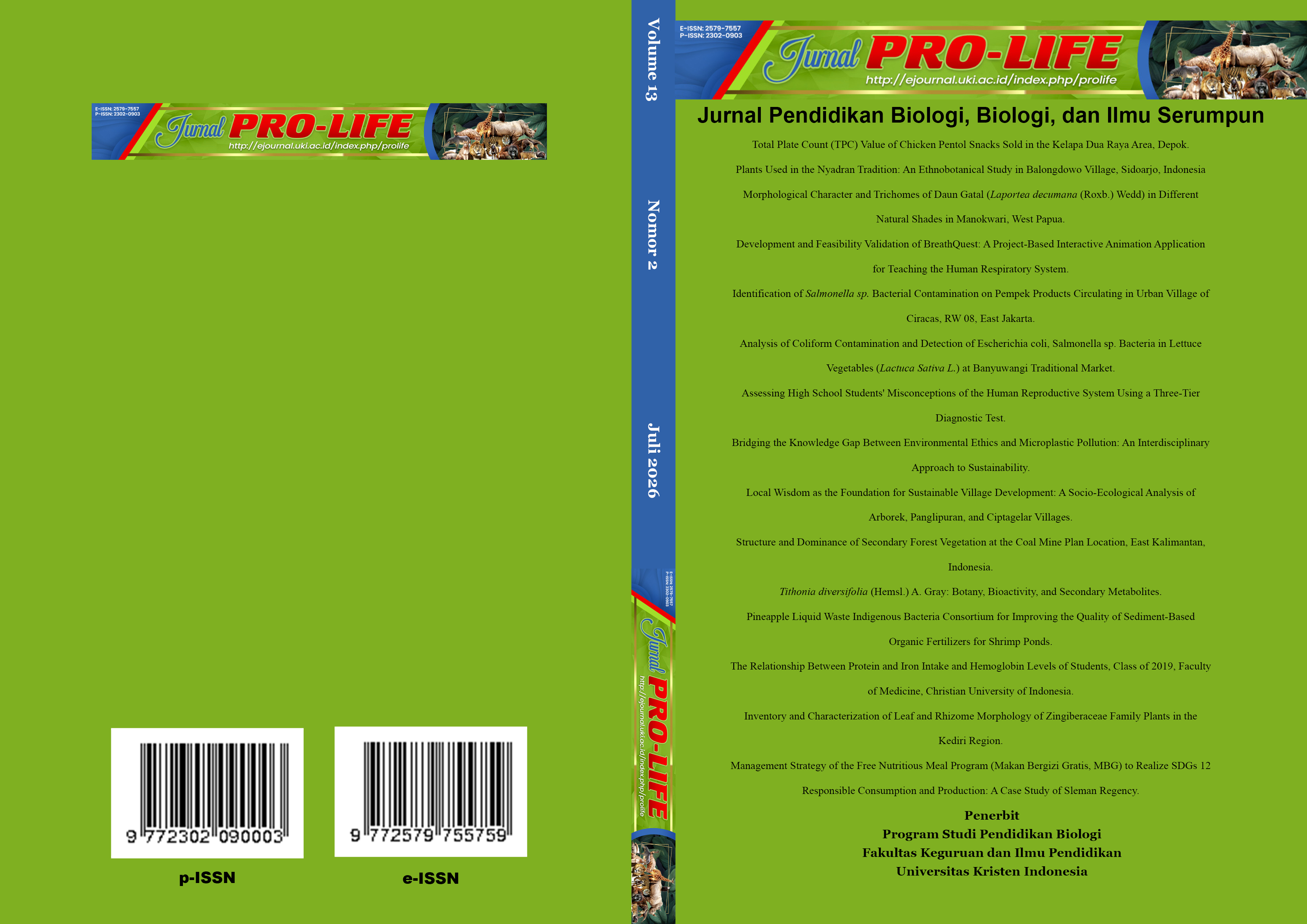
Structure and Dominance of Secondary Forest Vegetation at the Coal Mine Plan Location, East Kalimantan, Indonesia
DOI:
https://doi.org/10.33541/pro-life.v13i2.8160Keywords:
Vegetation structure, species dominance, Importance Value Index, secondary forestAbstract
This study documents vegetation biodiversity in the secondary forest area of the PT Alhasanie coal mining concession, East Kalimantan, Indonesia, as part of the pre-mining environmental baseline survey. Surveys were conducted in 2024 using a systematic nested plot design, "strip plot," across four vegetation strata: tree DBH ≥20 cm; pole DBH 10–19.9 cm; sapling height ≥1.5 m; DBH <10 cm; and seedling (height <1.5 m). Species composition and community structure were quantified using the Importance Value Index (IVI). A total of 32 plant species were recorded. Paraserianthes falcataria dominated the tree stratum (IVI = 149.98), Macaranga gigantea dominated both the pole (IVI = 97.59) and sapling (IVI = 115.45) strata, and Eupatorium odoratum dominated the seedling stratum (IVI = 44.57). Across all strata, the vegetation is overwhelmingly composed of pioneer, disturbance-adapted, and invasive species; Dipterocarpaceae are virtually absent from the upper strata and represented only by a single Shorea leprosula individual in the sapling layer. These findings confirm a severely disturbed young secondary forest with a clear history of shifting cultivation and land encroachment—no protected species under Indonesian Ministry of Environment and Forestry Regulation No. P.106/MENLHK/SETJEN/KUM.1/12/2018 were recorded. The survey results serve as the reference condition for environmental impact assessment and provide the ecological foundation for post-mining land rehabilitation planning.
References
Ashton, P. S. (2008). Dipterocarpaceae. In K. Kubitzki (Ed.), Flowering plants: Dicotyledons (pp. 190–231). Springer.
Brown, S., & Lugo, A. E. (1990). Tropical secondary forests. Journal of Tropical Ecology, 6(1), 1–32. https://doi.org/10.1017/S0266467400003989
Charomaini, M., & Suhaendi, H. (1997). Paraserianthes falcataria: Genetic resources and improvement. In J. W. Turnbull, H. R. Crompton, & K. Pinyopusarerk (Eds.), Recent developments in Acacia planting (pp. 263–268). ACIAR.
Chazdon, R. L. (2014). Second growth: The promise of tropical forest regeneration in an age of deforestation. University of Chicago Press.
Chazdon, R. L., & Guariguata, M. R. (2016). Natural regeneration as a tool for large-scale forest restoration in the tropics: Prospects and challenges. Biotropica, 48(6), 716–730. https://doi.org/10.1111/btp.12381
Connell, J. H., & Slatyer, R. O. (1977). Mechanisms of succession in natural communities and their role in community stability and organization. The American Naturalist, 111(982), 1119–1144. https://doi.org/10.1086/283241
Curtis, J. T., & McIntosh, R. P. (1951). An upland forest continuum in the prairie-forest border region of Wisconsin. Ecology, 32(3), 476–496. https://doi.org/10.2307/1931725
Davies, S. J., Lum, S. K. Y., Chan, R., & Wang, L. K. (2001). Evolution of myrmecophytism in western Malesian Macaranga (Euphorbiaceae). Evolution, 55(8), 1542–1559. https://doi.org/10.1111/j.0014-3820.2001.tb00675.x
Food and Agriculture Organization of the United Nations. (2020). Global forest resources assessment 2020: Main report. https://doi.org/10.4060/ca9825en
Gaveau, D. L. A., Sheil, D., Husnayaen, Salim, M. A., Arjasakusuma, S., Ancrenaz, M., Pacheco, P., & Meijaard, E. (2016). Rapid conversions and avoided deforestation: Examining four decades of industrial plantation expansion in Borneo. Scientific Reports, 6, 32017. https://doi.org/10.1038/srep32017
Hapsari, L. (2021). Plant diversity and conservation values of Kalimantan's forests: A review and prospective analysis. Biodiversitas, 22(5), 2688–2705. https://doi.org/10.13057/biodiv/d220557
Indriyanto. (2006). Ekologi hutan. Bumi Aksara.
International Union for Conservation of Nature. (2024). The IUCN Red List of Threatened Species (Version 2024-1). https://www.iucnredlist.org
Karmini, Karyati, & Widiati, K. Y. (2021). The ecological and economic values of a 50 years old secondary forest in East Kalimantan, Indonesia. Biodiversitas, 22(10), 4597–4607. https://doi.org/10.13057/biodiv/d221053
Kementerian Lingkungan Hidup dan Kehutanan. (2017). Petunjuk teknik inventarisasi hutan. Direktorat Jenderal Planologi Kehutanan dan Tata Lingkungan.
Kettle, C. J. (2010). Ecological considerations for using dipterocarps for restoration of lowland rainforest in Southeast Asia. Biodiversity and Conservation, 19(4), 1137–1151. https://doi.org/10.1007/s10531-009-9772-6
MacKinnon, K., Hatta, G., Halim, H., & Mangalik, A. (1996). The ecology of Kalimantan. Periplus Editions.
Martínez-Ramos, M., Barraza-Medina, E., Mora, F., Ibarra-Manríquez, G., & Solís-Magallanes, J. A. (2021). Community-level patterns of long-term secondary succession in a human-disturbed tropical dry forest. Journal of Ecology, 109(3), 1613–1628. https://doi.org/10.1111/1365-2745.13586
Maycock, C. R., Thewlis, R. N., Ghazoul, J., Nilus, R., & Burslem, D. F. R. P. (2005). Reproduction of dipterocarps during low-intensity masting events in a Bornean rain forest. Journal of Vegetation Science, 16(6), 635–646. https://doi.org/10.1111/j.1654-1103.2005.tb02407.x
Mulyana, R., Ichsan, A. C., & Ngaloken, G. (2011). Dampak pertambangan batubara terhadap deforestasi hutan di Kalimantan Timur. Jurnal Penelitian Hutan dan Konservasi Alam, 8(1), 1–14.
Ngo, K. M., Turner, B. L., Muller-Landau, H. C., Davies, S. J., Larjavaara, M., Hassan, N. F. N., & Lum, S. K. Y. (2013). Carbon stocks in primary and secondary tropical forests in Singapore. Forest Ecology and Management, 296, 81–89. https://doi.org/10.1016/j.foreco.2013.02.004
Pham, T. T., Moeliono, M., Nguyen, T. H., Nguyen, H. T., & Vu, T. H. (2010). The context of REDD+ in Vietnam: Drivers, agents and institutions (CIFOR Occasional Paper No. 55). Center for International Forestry Research.
Rozendaal, D. M. A., Bongers, F., Aide, T. M., Alvarez-Dávila, E., Ascarrunz, N., Balvanera, P., ... Poorter, L. (2019). Biodiversity recovery of Neotropical secondary forests. Science Advances, 5(3), eaau3114. https://doi.org/10.1126/sciadv.aau3114
Russell, A. E., Raich, J. W., & Vitousek, P. M. (1998). The ecology of the climbing fern Dicranopteris linearis on windward Mauna Loa, Hawaii. Journal of Ecology, 86(5), 765–779. https://doi.org/10.1046/j.1365-2745.1998.8650765.x
Slik, J. W. F., Verburg, R. W., & Keßler, P. J. A. (2003). Effects of fire and selective logging on the tree species composition of lowland dipterocarp forest in East Kalimantan, Indonesia. Biodiversity and Conservation, 11(1), 85–98. https://doi.org/10.1023/A:1014511726484
Soerianegara, I., & Indrawan, A. (1998). Ekologi hutan Indonesia. Laboratorium Ekologi Hutan, Fakultas Kehutanan IPB.
Wahyu, A., Susanto, A., & Yusuf, R. (2023). Ecological restoration of post-coal mining areas in East Kalimantan: Challenges and perspectives. IOP Conference Series: Earth and Environmental Science, 1180, 012014. https://doi.org/10.1088/1755-1315/1180/1/012014
Whitmore, T. C. (1998). An introduction to tropical rain forests (2nd ed.). Oxford University Press.
Yamada, T., Tomita, M., Itoh, A., Yamakura, T., Ohkubo, T., & Ogino, K. (2000). Structure of a mixed dipterocarp forest and its response to logging in East Kalimantan, Indonesia. Plant Ecology, 151(2), 197–209. https://doi.org/10.1023/A:1026537400707
Yokota, M., Moog, O., & Imai, N. (2021). Evolution of secondary metabolites in invasive plant species Chromolaena odorata for defense and allelopathic functions. Plants, 12(3), 521. https://doi.org/10.3390/plants12030521
Downloads
Published
How to Cite
Issue
Section
License
Copyright (c) 2026 Andi Yusuf, Nisrina Putri Hanifah

This work is licensed under a Creative Commons Attribution-ShareAlike 4.0 International License.












.svg_.png)